Design skills, Problem-solving, Global context, Environmental sustainability, Project management, Social and aesthetic awareness, Critical thinking
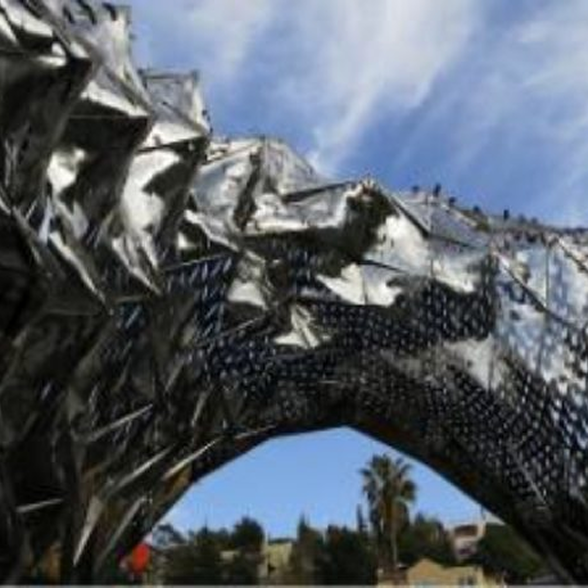
Base your prototype on a specific example given in the Doris Sung video, calculate precise architectural scaling for the prototype?
A kitchen table or flat surface
You will learn how to apply geometry and mathematics in architecture. This will include forces, airflow, construction skills, and how to design to a set brief. You will come away with a better understanding of biomimicry but most importantly it will encourage you to look at architecture differently, think sustainably, be able to manipulate materials, and learn to find inspiration from a range of sources.
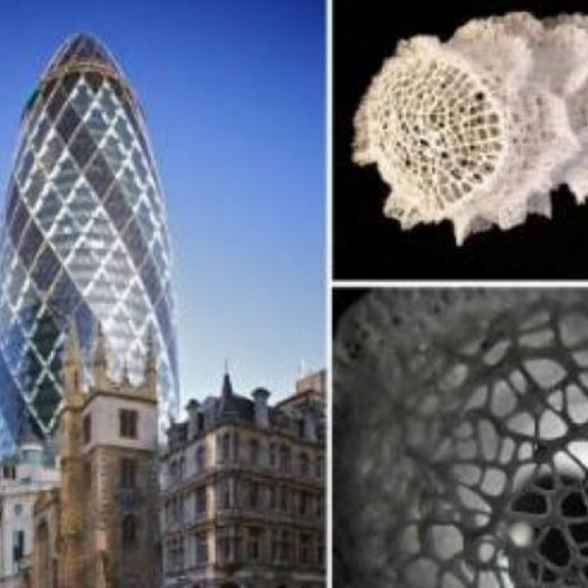
The Gherkin and Venus basket sponge pictured to show a real-life example and inspiration of the proposed problem.
You should then come up with a range of sketched ideas that are, in some way, inspired from your two chosen Group Research Areas or from examples 1 and 2.
Expert tip: try to repeat some of the inspiring aspects
To take your design further, start to experiment with either one or all of the following:
Begin making prototype(s) and or concepts models. This doesn’t have to be a finished working model. It could be a collection of small prototypes that help explain the idea. Models can be presented along with sketches.
Expert tip: Be as creative as you can with your materials. There are no rules!
Begin making prototype(s) and or concepts models. This doesn’t have to be a finished working model. It could be a collection of small prototypes that help explain the idea. Models can be presented along with sketches.
Expert tip: Be as creative as you can with your materials. There are no rules!
We’d love to see the outcome of your design – send pictures to hello@asu-london.ac.uk.