
Priority application window open – Apply now
Home fee (UK and Ireland)
International fee

Curious about the tech that powers robotics, smart factories, and intelligent machines? This course is your launchpad. Engineering with Mechatronic Systems gives you the skills to design, build and optimise the smart, sustainable systems of the future — blending mechanics, electronics, computing, and control into powerful real-world solutions.
You won’t just learn the theory — you’ll do the doing. From automation and robotics to the Internet of Things, cybersecurity, and intelligent control systems, you’ll dive deep into the technologies shaping Industry 4.0. Along the way, you’ll explore how to design for sustainability, manage supply chains, and drive innovation from concept through to creation.
We emphasise sustainability and global responsibility, encouraging you to be socially responsible and inclusive engineers who act as trusted agents of public good.
Graduates are well-prepared to apply their theoretical and practical knowledge innovatively in real-world scenarios, making positive impacts in organisational developments.
You’ll gain a forward-looking education that aligns with the principles of Engineers 2030, preparing them to be socially responsible and inclusive engineers.

Get ready to take control (literally) as you explore the world of smart systems. Learn how sensors, actuators, and control systems work together to bring machines and devices to life. Analyse how machines sense, react, and make decisions. Design and simulate control systems, the kind that keep robots balanced, cars on course, and industrial systems running smoothly.
Using industry software such as MATLAB/Simulink and microcontroller platform (e.g. Arduino), you’ll build simulations, analyse system responses, and design control strategies. Through structured coding exercises and practical workshops, you’ll get comfortable working with feedback systems, transfer functions, and system stability.
By the end, you’ll be able to model dynamic systems, design and test controllers, and understand the role of sensors and actuators in smart, automated solutions. It’s a practical, project-based experience built around real tools and real challenges.
You’ll start by building up your fundamental skills of dynamics, and develop your proficiency in modelling and simulation, along with your programming skills. No need to be an expert – we’ll help you get comfortable using programming tools like MATLAB to create smart, effective solutions. Exploring how motion, forces, and energy interact in physical systems, and how to simulate all of that with code.
You’ll work in a team to take on a real-life engineering scenario. Together, you’ll design, build, and present a working simulation, explaining your approach and showing off the code behind it.
By the end, you’ll be able to think like an engineer, build digital models of physical systems, and make decisions based on real life data. You won’t just understand the theory, you’ll put it into action. It’s hands-on, fast-moving, and focused on the kind of skills you’ll use in your future career.
You’ll be solving problems, designing products, and making big decisions as part of a team.
You’ll dig into the fundamentals of solid mechanics, materials science, and manufacturing but you won’t just study them. You’ll use them. You’ll choose materials, model your design with Computer Aided Design (CAD) software, run stress tests, and figure out how to make it – all while thinking about quality, cost, flexibility, safety, ethics, and sustainability.
Along the way, you’ll build serious skills in CAD, stress analysis, and design thinking. Get better at presenting ideas, working with others, and backing up your decisions with solid reasoning. Expect to be challenged, to inspire others, supported, and maybe even surprised by what you can create, break or make.
It’s fast-paced, practical, and packed with the kind of experience that makes you stand out. This is engineering the way it should be, hands-on, real-world, and all about bringing your ideas to life.
Undertaking a design challenge, you’ll demonstrate your leadership and impact in engineering. Working on a real-life global challenge, underpinned by the UN Sustainability Goals, you’ll cover environmental, ethical, commercial, social, governance and cultural aspects of engineering.
Reflecting on your strengths and contributions, you’ll develop your teamwork, research, communication and problem-solving skills. These key skills are important for developing your professionalism as an engineer.
All modules are subject to change and availability. If a module changes after you have been made an offer, you’ll be notified before you start your course.

In the second year of study your focus will shift from engineering fundamentals to mechatronics systems principles and their applications.
Understand and apply the principles and applications of structural, mechanical, and civil engineering for the design of modern structures. You’ll explore the essential principles of structural engineering and examine their role in the analysis and development of a wide variety of engineering structures across civil, mechanical, and industrial contexts.
You’ll work on real world engineering structures, considering not just the engineering loading but the sustainability, health and safety, quality codes and regulations you must follow to optimise your design.
Appraise and apply ecologically responsible design principles to minimise the environmental impact of your ideas. Working on an eco-design product, process or construction, you’ll assess ecological considerations, whilst applying mathematical, scientific and engineering principles and modelling. Using an ecological approach to design, you’ll consider energy and carbon, the circular economy and materials, climate resilience, biodiversity and water as well as related aspects of well-being. Collaborating in teams, you’ll evaluate the relationship between design, cost and the ethical and legal requirements in the design of buildings. Advancing your knowledge of the underlying engineering principles.
All modules are subject to change and availability. If a module changes after you have been made an offer, you’ll be notified before you start your course.
All modules are subject to change and availability. If a module changes after you have been made an offer, you’ll be notified before you start your course.
As soon as you start you’ll be on a fast-track to complete your bachelor’s degree and master’s degree in four years.
You’ll learn through a mix of hands-on labs, makerspace projects, simulations, and problem-based learning.
Group projects let you tackle real-world engineering challenges, developing teamwork, problem-solving and communication skills while designing, testing, and analysing circuits, sensors, actuators, and systems.
Maths and digital skills are taught in context, helping you apply them confidently across all areas of electronic and electrical engineering. Assessments mirror industry practice, preparing you for the challenges of professional engineering.
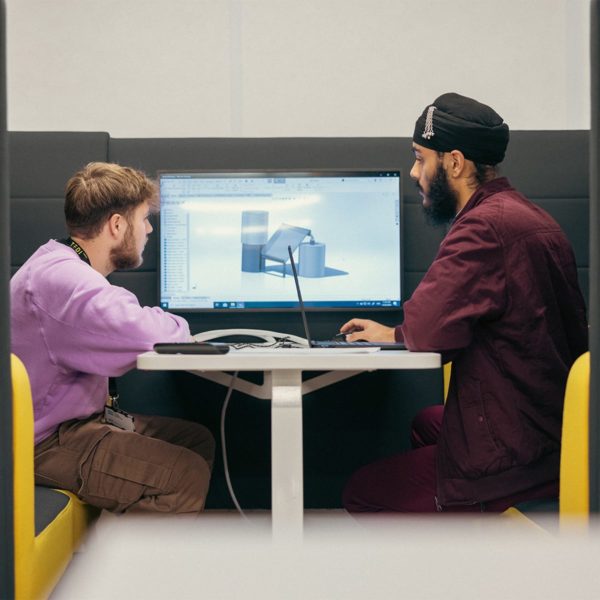
Typical assessment methods at ASU London include a mixture of group project reports, individual reports, pitches, presentations, demonstrations, short videos, portfolio development and posters. This diverse range of assessment methods ensures that you demonstrate your understanding and skills in multiple ways, catering to different learning styles and preferences.
Collaboration with industry throughout your studies is core to the ASU London experience. The programme is designed to be industry-focused, ensuring that you are not only learning theoretical concepts but also applying them in real-world scenarios. Though specific industry partners identification is on-going, the programme will involve co-designing with industry to ensure that the curriculum is aligned with real-world needs and challenges.
ASU London emphasises regular industry interaction as part of its project-based learning approach. Students will engage with industry experts in a professional capacity from the very start of their programme. This includes meeting industry professionals during projects and masterclasses, which allows students to build their professional networks and gain insights into various sectors. Many projects will involve working in small teams to deliver solutions to real client partners, managing the project from end-to-end, including research, design ideation, prototyping, and presenting the solution.
This hands-on approach ensures that students gain practical experience and develop vital skills like collaboration, communication, project management, and commercial awareness, making you well-prepared for the workplace.

Our entry requirements are designed to open pathways to higher education for students from a wide range of academic backgrounds. Like Arizona State University, we measure our success not by whom we exclude, but by whom we include – and how well they thrive.
The criteria below are provided as a guide to help you determine whether ASU London is the right fit for you:
You can view our full list of country specific entry requirements on our Entry requirements page.
English language requirements: English level can only be demonstrated through an IELTS Academic for UKVI minimum score of 6.0 (with no less than 5.5 in all skills).
Visas: For more information on student visas and work rights, please visit our student visa page.
Scholarships: The Inaugural Global Scholarship is now open for international students. Learn more about funding opportunities here.

Looking for an accelerated way to earn two powerful degrees and launch your international career? ASU London offers students a
UK-accredited degree enhanced by the globally recognised curriculum of Arizona State University, ranked the #1 most innovative university in the US for 11 consecutive years by U.S. News & World Report, with US master’s degree pathways integrated directly into your programme. The master’s degree is developed by Arizona State University’s highly-ranked Ira A. Fulton Schools of Engineering.
Accelerate your future and graduate with both a bachelor's and a master's degree in just 4 years, saving time and expense. And, your pathway to the US is guaranteed if you meet entry requirements.
Study across both the UK and US and double your career connections and prospects. If you want global opportunities for a career, this is your perfect place to start.
With practical, real-world learning and problem-solving to gain valuable professional skills, every ASU London degree is inspired by the university ranked #1 in the US for innovation by U.S. News & World Report for 11 years running.
Earn a degree shaped by innovation, technology, and AI, designed to better prepare you for the careers of today and the future.
Study in London. Study in the US. Earn two degrees and double your experience in two of the world’s most exciting places to learn and live.
Earn a master’s from Arizona State University and tap into over one million alumni, 650+ global industry partners - including EY, Amazon, Apple, Intel, Microsoft, NVIDIA, Boeing, and Goldman Sachs - plus strong UK collaborations for global career opportunities.
Join the next ASU London event to learn more about the Engineering with Mechatronics Systems degree programme.



TEDI-London was the brainchild of three leading names in engineering education. Arizona State University, King’s College London, and UNSW Sydney were already working together to tackle global problems as part of the PLuS Alliance when they saw the need for more diverse, creative-thinking engineering students. TEDI-London was the answer.
Hear from our students about the excitement they find in every day at ASU London.